
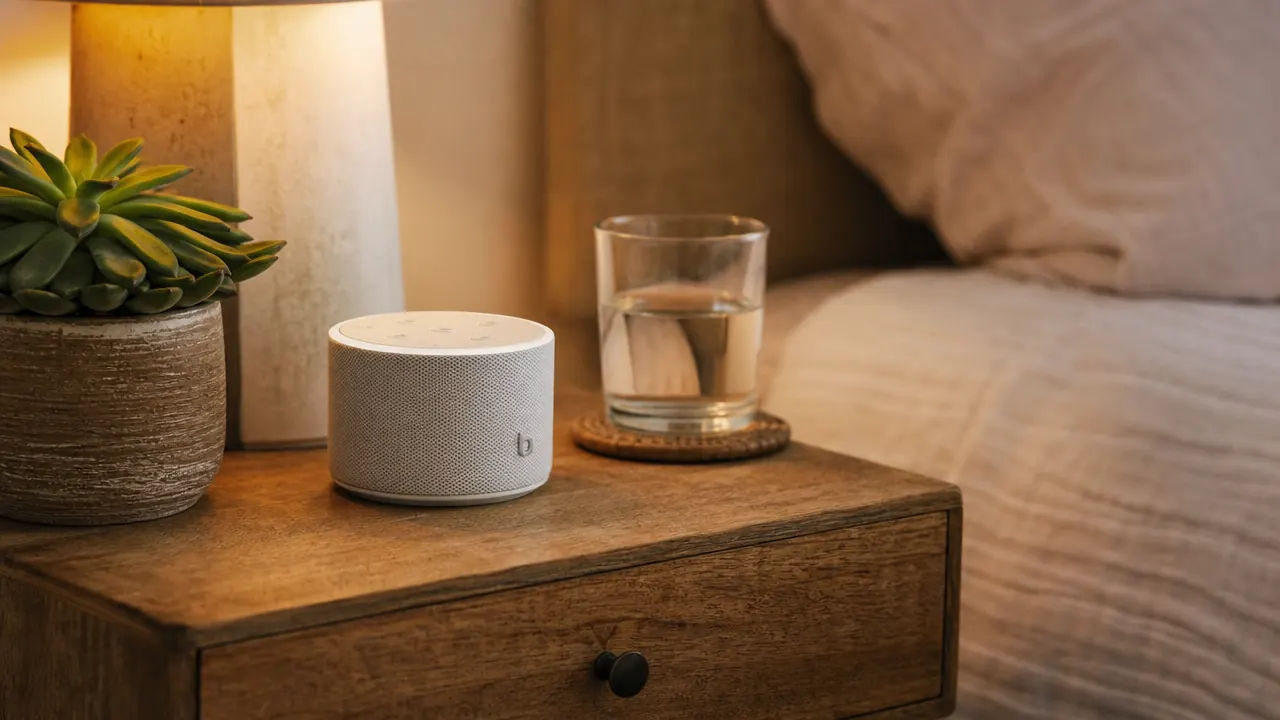
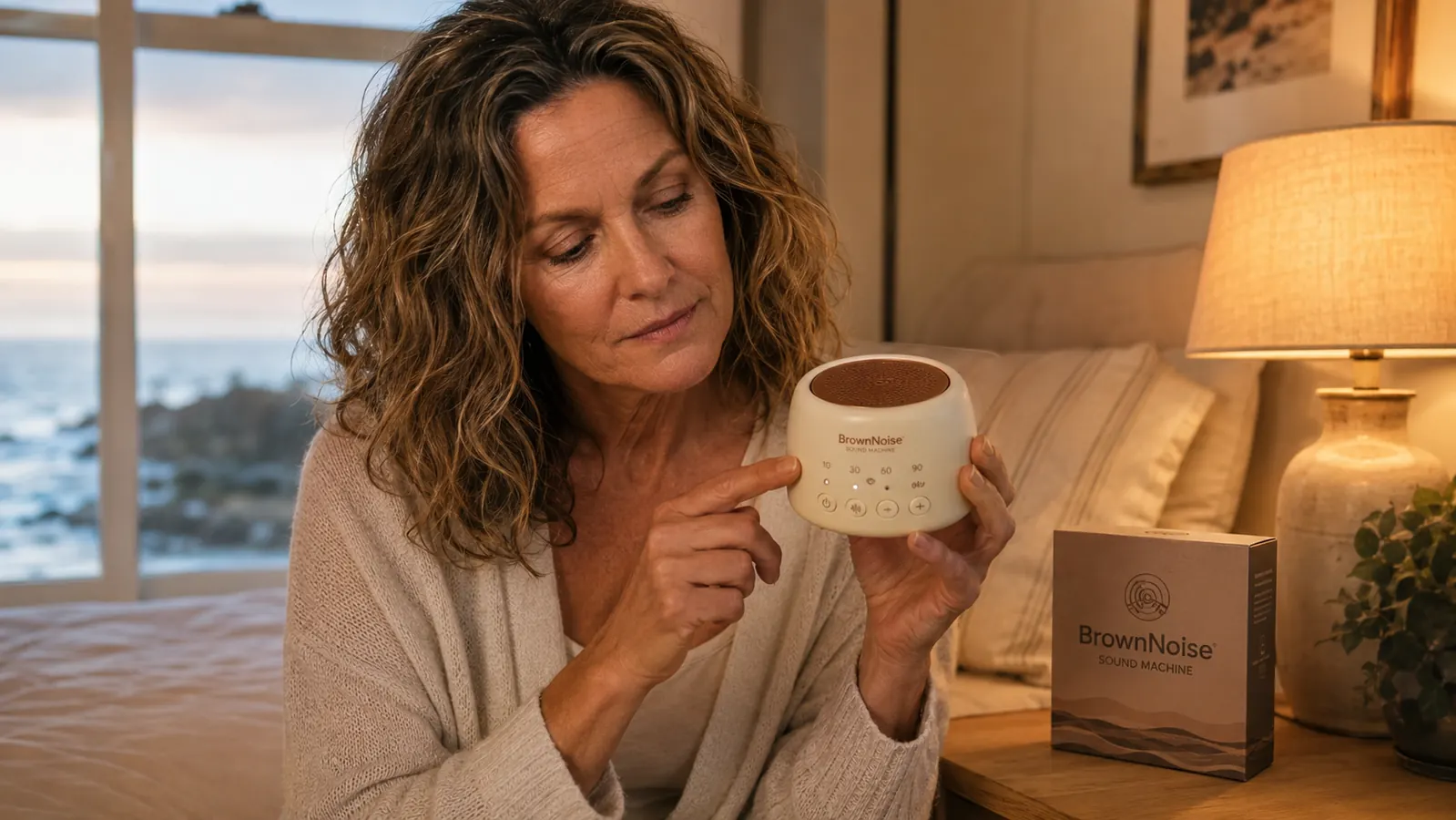
Let me tell you what the listing does not. It does not tell you that sound number seven has a faint click at the end of every loop. It does not mention that the lowest setting on the night light still throws enough glow to interrupt your sleep if you are even mildly light-sensitive. It does not warn you that if the power goes out at 2 AM and you reset the thing, it will have completely forgotten your settings and cheerfully start playing a children's lullaby at full volume. I know all of these things now because I spent two months going through every one of the 30 sounds on the BrownNoise Sound Machine with 30 Soothing Sounds, turning it off and on, adjusting volumes, watching the clock, and writing notes in a little pad I keep by the bed. I am a retired artist and former professional cook. I live near the water, which means I have heard real ocean sounds my whole life. I know what rain actually sounds like. And I had opinions.
I want to be clear before anything else: I still run this machine every single night. It sits on my nightstand right now. But the reasons I keep it are different from the reasons I ordered it, and the things that annoyed me in weeks one and two are real enough that you deserve to know about them before you spend your money. This is the honest version. The long-term comfort review is its own piece. This one is about what nobody told me.
The Quick Verdict
A genuinely useful sound machine let down by a looping seam on several tracks, a night light that is too bright at minimum, and settings that reset on power loss. Brown noise and the fan sounds are excellent. Worth it if you know what you are getting.
Amazon Check Today's Price →Restless nights from outside noise? Brown noise costs less than a night out and works by morning.
The BrownNoise Sound Machine has 30 sounds, a built-in night light, and fits on any nightstand. At current pricing it is hard to argue against trying it.
Amazon Check Today's Price on Amazon -> →How I Actually Tested It
I placed the machine on the left nightstand, about three feet from my head, which is roughly where my bedroom lamp sits. I kept a small notepad and a pen with a clip-on light so I could write without turning anything on. Every night for eight weeks I noted which sound I used, what volume I ran it at, whether I woke during the night, whether the loop seam woke me or pulled me out of a half-sleep, and how I felt about it in the morning. My husband is a heavier sleeper than I am, so he was not much help as a second opinion, but I did occasionally ask him whether he could hear the loop click from his side of the bed. He could not. I could.
I went through all 30 sounds at least twice. The first pass was just listening while sitting up in bed, fully awake, with the room otherwise quiet. The second pass was overnight, trying to fall asleep with each sound. A few sounds I ran for three or four nights in a row to be fair to them. The night light I tested separately by sitting in a dark room and cycling through all twelve colors at all three brightness levels to see which ones I could actually tolerate. I am not a scientist. I am a 64-year-old woman who has not slept well since her fifties and has tried most things short of prescription medication. Take my observations for what they are.
The Looping Problem: Real, Not Imagined
This is the thing I wish someone had told me plainly. Several of the 30 sounds are looped audio files, and on some of them the edit point is audible. Not on all of them, and not always at all volumes, but it is there. The sounds most affected in my testing were the babbling brook, the campfire crackling, and the thunderstorm. The thunder in particular has a pattern that repeats on a cycle short enough that by night three I was anticipating it. That is the opposite of what you want from a sleep sound.
The sounds that do not have this problem, or where the loop is long enough that I never noticed the seam, are the brown noise, white noise, pink noise, both fan sounds, and the steady rain. Those six are genuinely good. The brown noise especially is rich and consistent with no texture breaks. If I had known to just buy this machine for those six sounds and ignore the rest, I would have had a much smoother first two weeks. Instead I spent those weeks cycling through thunderstorms and babbling brooks wondering if I was imagining things. I was not.
The Night Light: More Trouble Than It Is Worth, Usually
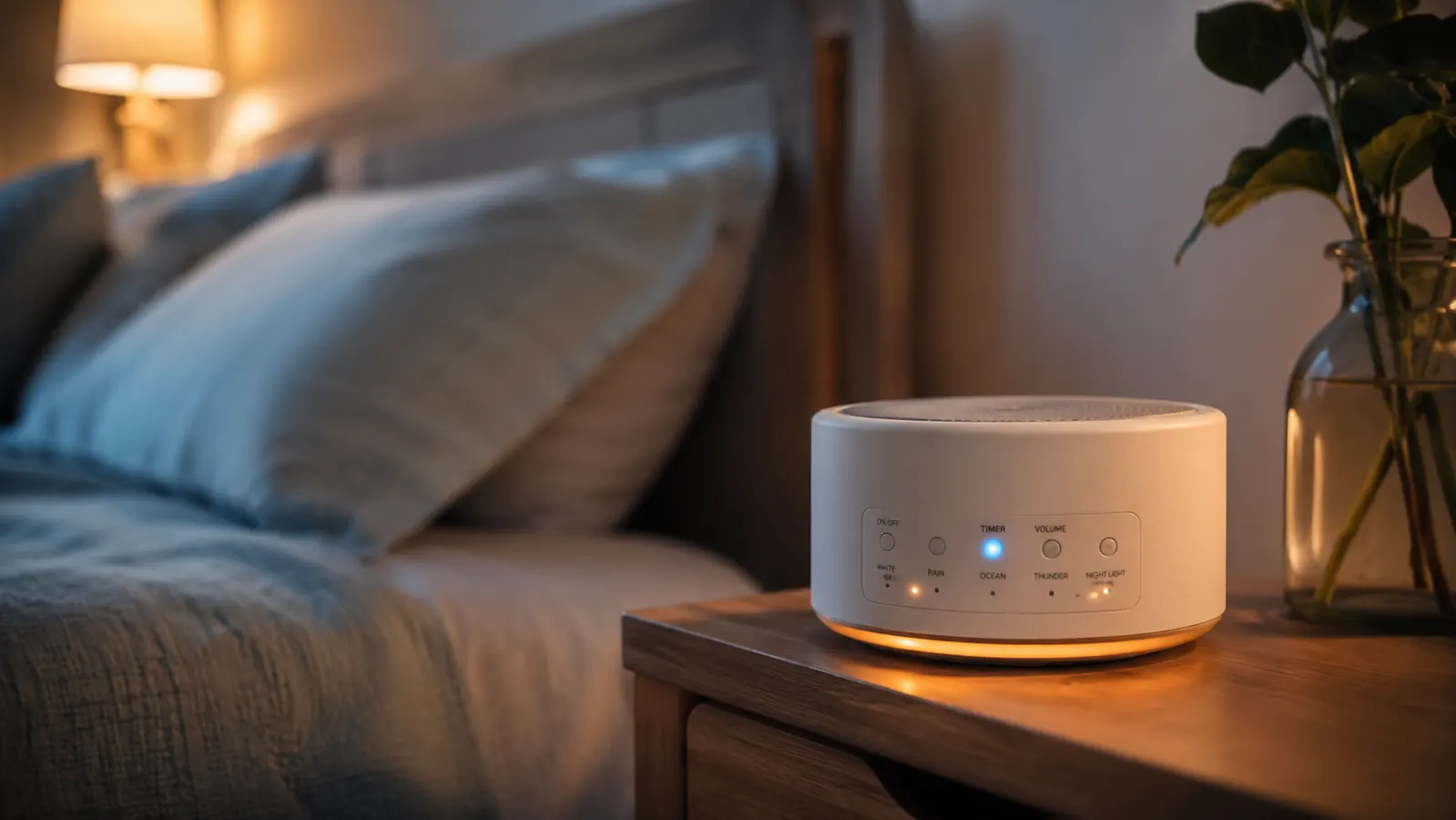
The machine comes with a built-in night light that cycles through twelve colors at three brightness levels. The marketing leans into this hard, and I understand why because it looks impressive in a photograph. In actual use in a dark bedroom, the lowest brightness on most colors is still enough to bother me. I am not unusually light-sensitive. I just happen to sleep in a room that is genuinely dark because I have blackout curtains and no street light. If you are in that kind of room, even the lowest blue or white setting reads as a noticeable light source.
The colors that work at minimum brightness, in my experience, are the amber and the red-orange. Those read as a warm barely-there glow rather than a lamp. Everything else, including the cooler whites and blues, was too much for me. I ended up turning the night light off entirely and just running the sound. If night-light functionality is a priority for you, this works well in a room that is not already very dark. If you are trying to keep your bedroom pitch black, budget for turning that feature off.
I spent two weeks cycling through thunderstorms and babbling brooks wondering if I was imagining the loop. I was not. But I also discovered six sounds that are genuinely excellent, and one of them changed my nights completely.
Too Many Modes, Not Enough Memory
Thirty sounds sounds like a feature until you are trying to find the one sound you liked last Tuesday in the dark without your reading glasses. The buttons are small. There is no display. You cycle through sounds by pressing the same button repeatedly, which means if you overshoot and go one past brown noise, you are pressing the button another 29 times to get back to it. In my first two weeks I occasionally gave up and just left it on whatever sound I had landed on. That is a design problem, not a user error.
The memory reset issue is separate and more serious. This machine does not retain your sound selection or volume level if it loses power. A power blip, a tripped circuit, a storm that cuts the electricity for thirty seconds, and you wake up to the factory default sound at the factory default volume. In my case that happened once in eight weeks during a brief outage. I woke to a loud lullaby. I was not happy. If you live somewhere with reliable power and no overnight outages, this is a theoretical problem. If you live near the coast and lose power a few times a year during storms, it is worth knowing.
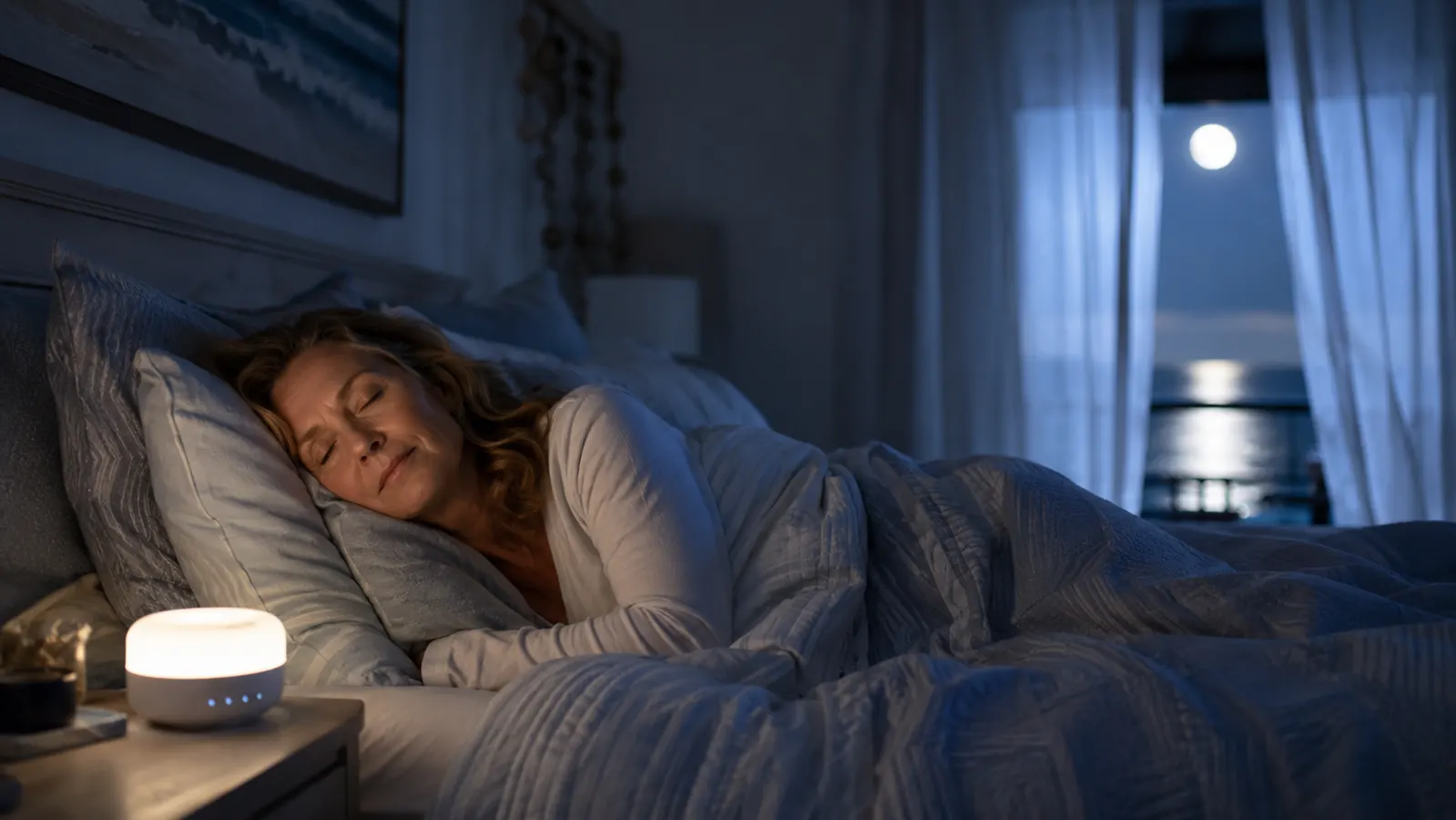
Brown Noise vs White Noise: The Answer Nobody Is Giving You
I had never consciously tried brown noise before this machine. I had run white noise apps on my phone and a small travel fan for years, but brown noise was new to me. The difference is immediately clear. White noise has a higher-pitched hiss that some people find harsh over time. Brown noise sits lower in the frequency range, with a deeper rumble that feels closer to the sound of ocean surf from a distance or wind through trees. It is warmer and less fatiguing to listen to for hours.
For me, personally, brown noise was the discovery. I ran it every night for the last five weeks of my test and it was the sound that consistently got me to sleep fastest and kept me there through the small sounds that used to wake me, my neighbor's car door at 5:30 AM, the garbage truck, my husband getting up early. It does not eliminate those sounds. It blunts their sharpness so they do not cross the threshold that pulls me out of sleep. That is exactly what I needed. Pink noise, which splits the difference between white and brown, is also good and I know some people prefer it. For me, brown noise won.
Who This Is For
You are a good fit for this machine if you are woken by intermittent sounds: traffic, neighbors, a partner who gets up early, morning birds, or household sounds that come and go unpredictably. You are also a good fit if you have never owned a dedicated sound machine before and want to try one without spending a lot of money. At the current price this is a low-stakes experiment. The worst case is that you discover white noise is not for you and you have lost very little. The best case is that you find the one or two sounds that work for your ears and you start sleeping through things that used to wake you.
You are also a good fit if you travel and want something small. This machine is compact enough to pack easily and the USB-C charging means it works with the same cable as your phone. I took it with me on a trip to visit my daughter and it made sleeping in her guest room easier than it would otherwise have been.
Who Should Skip It
Skip this machine if the looping audio issue is likely to bother you. If you are the kind of person who notices when music loops in a store, you will notice it here on the nature sounds. You will not be able to un-notice it. If you want purely nature-based ambient sounds that sound genuinely real and seamless, you are better served by a dedicated app on a device you already own, or a higher-end machine that uses longer or randomized audio files.
Skip it if a bright night light is important to you at its lowest setting. And skip it if you need it to remember your settings through a power interruption. For light sleepers in areas with frequent power fluctuations, the memory reset issue is a real quality-of-life problem.
Also consider skipping it if your main sleep disruptor is a partner who snores. A sound machine masks external sounds but it cannot fully cover a noise source that is next to you in bed. Some people find it helps enough to matter. Others do not. That is a category where results genuinely vary and I would not want you to expect too much.
If you want a more detailed look at whether a sound machine beats running a fan at night, I walked through that comparison in a separate article on white noise machine vs fan for sleep. And if you are new to the idea of sound masking entirely, the piece on 10 reasons a sound machine helps you sleep explains the underlying mechanics in plain language.
What I Liked
- Brown noise and fan sounds are genuinely excellent, consistent, and loop-free
- Compact and lightweight, easy to travel with
- USB-C charging means one less adapter to carry
- Wide enough volume range to work in noisy hotels or quiet coastal bedrooms
- Night light amber setting is pleasant as a dim, non-disruptive glow
- Price point makes it low risk to try for the first time
Where It Falls Short
- Several nature sounds, including the brook and thunderstorm, have an audible loop seam
- Night light at minimum brightness is still too bright for a pitch-dark bedroom on most colors
- No memory for sound or volume settings after power loss
- Cycling through 30 sounds in the dark without a display is frustrating
- Button labeling is minimal and hard to read in low light
- No timer function to auto-off after you fall asleep
Why I Still Use It Every Night
After all of that, here is the plain truth. I narrowed this machine down to two sounds: brown noise and the indoor fan. I set the volume the same way every night. I turned the night light off. And I stopped thinking about the other 28 sounds entirely. Once I had done that, the machine became simple and reliable. The brown noise runs from the time I turn off my lamp until my alarm goes off in the morning. It masked a garbage truck at 5:50 AM on Tuesday. It kept me asleep through my neighbor's dog barking on Thursday evening while I was in that light first-sleep window when I used to wake easily. I am sleeping longer and waking more slowly than I was before I had it.
If I am honest, the machine I wanted was a device with six carefully curated sounds and no looping problems and a completely dark face when idle. That machine probably costs more. This one, with its slightly too bright night light and its looping brook and its 30 sounds I narrowed to two, costs less than the dinner I made for company last Saturday. And it works. Those are the facts I did not have before I bought it, and now you do.
If brown noise is the sound that finally works for you, this is the cheapest reliable way to find out.
The BrownNoise Sound Machine is compact, USB-C charged, and the brown noise track is genuinely good. Turn off the night light, pick your sound, and give it one week.
Amazon Check Today's Price on Amazon -> →